The Program
Four weeks that start a career.
Nine sessions inside Wrigley Coffee, a working café. Students who meet the standard earn a Hospitality Certificate: proof they are ready for a job site, with real skills in communication, teamwork and workplace etiquette.
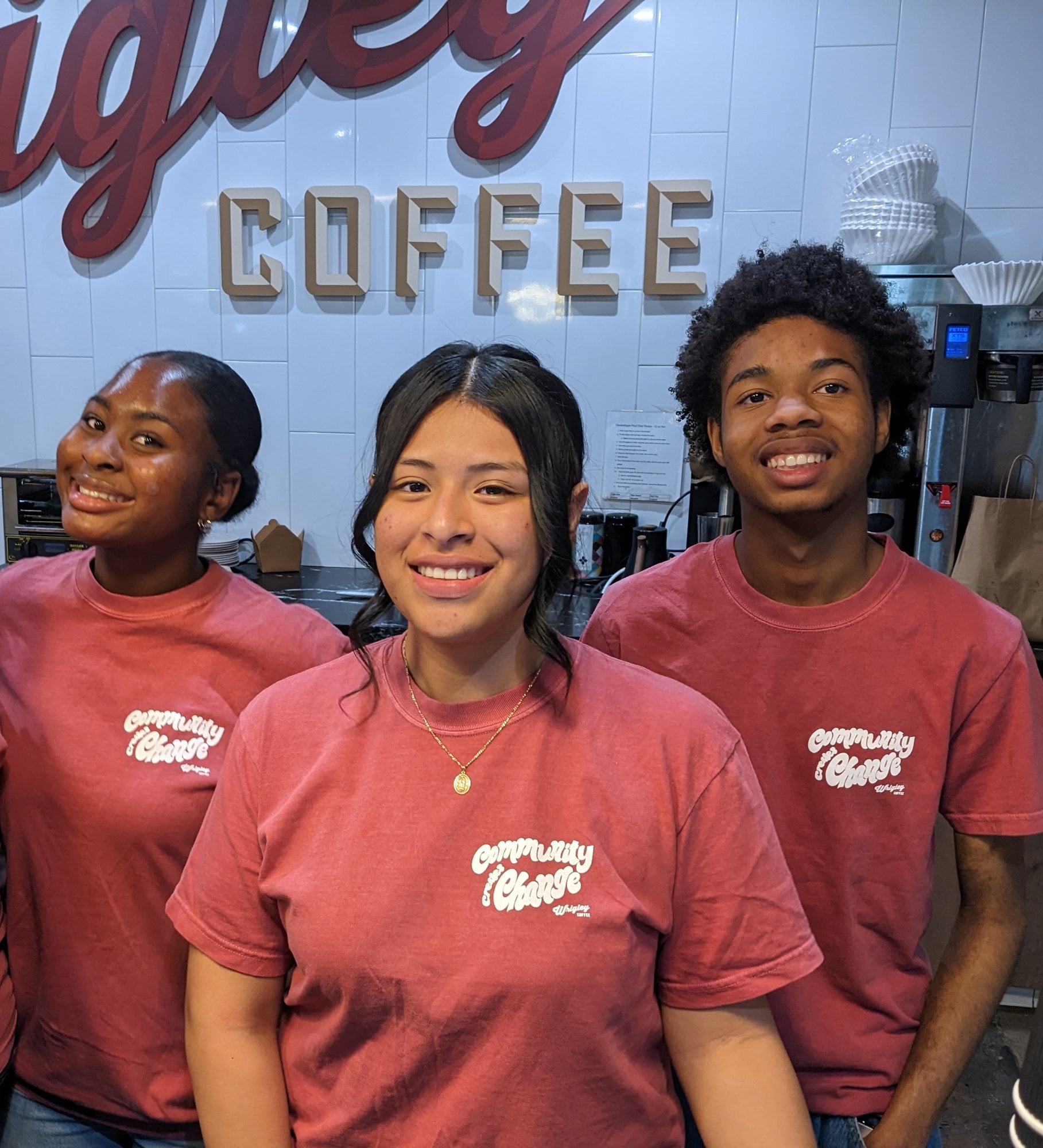
Photo: Spring 2026 pilot students, behind the counter. This is the classroom.
- Who
- 10 students per cohort, in grades 11 and 12, age 16 and up
- When
- Tuesdays and Thursdays, 4:00 to 8:00 PM
- Fall 2026
- Oct 13 to Nov 5, then the Showcase on Fri, Nov 6
- Total hours
- 36
- Where
- Wrigley Coffee, 437 W Willow St, Long Beach
Learn. Show. Launch.
Three steps, from the first day to what comes next.
- 1
Learn
A four-week cohort at Wrigley Coffee. Ten students, Tuesdays and Thursdays after school.
- 2
Show
The Community Showcase. Students prepare and serve specialty drinks for family, friends and neighbors.
- 3
Launch
Grads leave with a Hospitality Certificate and the skills a workplace needs. Every grad keeps getting career mentoring, so employers meet people who are prepared and supported.
After the Showcase
How interns are chosen
After the Showcase, some students go on to internships.
Internships are competitive, and no student is promised one.
Students are chosen on attendance, skills, the Showcase and an interview.
How many we can offer depends on funding and on what local businesses need.
- Communication
- Professionalism
- Teamwork
- Problem solving
- Career planning
- Food safety
- Customer service
- Cash handling
What students learn, week by week.
Nine sessions this fall. Open any week to see each day.
Week 1 · Oct 13 and 15
Show up
Workplace norms come first: showing up, owning mistakes, privacy and boundaries. Plus dress and hygiene. Then how to talk with guests.
Week 1 · Oct 13 and 15
Show up
- Tue, Oct 13Welcome and workplace normsA tour of the café. Then the four workplace norms: showing up, owning mistakes, privacy and boundaries. Plus dress, grooming and hygiene.
- Thu, Oct 15Talking with coworkers and guestsTone, body language, listening and word choice. Then customer service practice, and a first lesson on money.
Week 2 · Oct 20 and 22
Stay safe, set goals
Food safety, from handwashing to the three-compartment sink. Then personal goals, resumes and the job search.
Week 2 · Oct 20 and 22
Stay safe, set goals
- Tue, Oct 20Food safety and personal goalsHandwashing, keeping milk cold, first in first out and the three-compartment sink. Then each student sets a goal and the steps to reach it.
- Thu, Oct 22Resumes and job searchTurning everyday experience into a resume, and where to look for a first job. Then budgeting.
Week 3 · Oct 27 and 29
Behind the counter
Pulling espresso, steaming milk and drink recipes. Then the register: taking orders and making change.
Week 3 · Oct 27 and 29
Behind the counter
- Tue, Oct 27Coffee basics and steaming milkPulling espresso shots, following drink recipes and steaming milk safely. Then practice.
- Thu, Oct 29The registerEntering orders, asking the right questions, making change and keeping orders moving. Then practice orders, with every student in every role.
Week 4 · Nov 3, 5 and 6
Serve for real
Two rounds of practice service. Plus a 30-second introduction, references and thank-you notes. Then the Showcase.
Week 4 · Nov 3, 5 and 6
Serve for real
- Tue, Nov 3Practice service, networking and referencesStudents run the café for each other as cashier and barista. Then a 30-second introduction, how to ask for a reference and how to say thank you.
- Thu, Nov 5Credit, budgeting and the final practiceA lesson on credit and budgeting. Then the final practice service.
- Fri, Nov 6Community ShowcaseStudents prepare and serve specialty drinks for family, friends and neighbors.

Bankers from Farmers & Merchants Bank teach three sessions on budgeting, credit and money basics.
A typical sessionFrom check-in at 4:00 to a closing reflection.
- 4:00Welcome and check-inEvery student is greeted by name. A quick check-in, then a preview of the day’s skill.
- 4:15The day’s main lessonOne skill, taught for an hour. It builds on the session before.
- 5:15Independent work, or a one-on-one check-inLow-stakes practice on the day’s skill, with a facilitator close by. In weeks three and four, coaches check in with students here.
- 5:30Dinner togetherEveryone sits down to eat.
- 6:00A second lesson, or hands-on practiceBehind the counter, at the register, or in a practice service.
- 7:15Practice or independent workStudents repeat the day’s skill until it feels natural.
- 7:45Closing reflectionOne question about the day. Every student answers. Then a look ahead to the next session.
Most Tuesdays and Thursdays follow this rhythm. Every session opens and closes the same way, so students always know what to expect.
One-on-one coachingHelp with what makes showing up hard.
Every student gets one-on-one coaching from a coach training in social work. We help with the things that make showing up hard, not just the coffee.
- One student at a time. A coach pulls one student aside for three to five minutes while the group keeps practicing.
- Everyone gets a turn. In weeks three and four, check-ins rotate so every student gets one.
- Three questions. How is the program feeling so far? What is one thing you are proud of this week? Is anything getting in the way of you being here or focused?
- Real follow-up. If something is getting in the way, the team follows up outside of session time.
- Coaching notes. We don’t share them with employers.
Showing up is a job skillThe attendance rule, and why it counts.
So is calling ahead. Employers look for both, so we practice both.
- The rule. Every session counts. If you can’t be there, tell us ahead of time.
- Running late? Students tell the program contact as soon as they can, the same way they would tell a manager.
- Why it counts. The certificate depends on attendance and the skills rubric.
- Taught on day one. The first lesson covers four workplace norms: showing up, owning mistakes, privacy and boundaries.
- What showing up means here. On time, prepared, and dressed for the shift.
A certificate that has to be earned.
The Hospitality Certificate is not automatic. It goes to students who meet the hospitality skills rubric and attendance.
A sample Hospitality Certificate.
What it takes to earn itThe standard, the test, attendance and the work.
- The standard
- A written hospitality skills rubric. Every student gets it on day one, so the standard is clear from the start.
- The test
- On the last day, a facilitator watches each student during live service and completes the rubric for each one.
- Attendance
- Every session counts. If you can’t be there, tell us ahead of time.
- The work
- Nine sessions over four weeks, inside Wrigley Coffee, a working café. In practice service, students switch roles every ten minutes: guest, cashier, first barista, second barista.
- State standards
- Aligned to California career technical education (CTE) hospitality standards: guest and employee safety, grooming and hygiene, safe food handling, customer service and cash handling.
Come see it for yourself.
Watch students at work at the Showcase on Fri, Nov 6, 5 to 7 PM, or tell us how your business would like to take part.